AI in Marketing Automation: Unlocking Efficiency and Personalization for Competitive Advantage
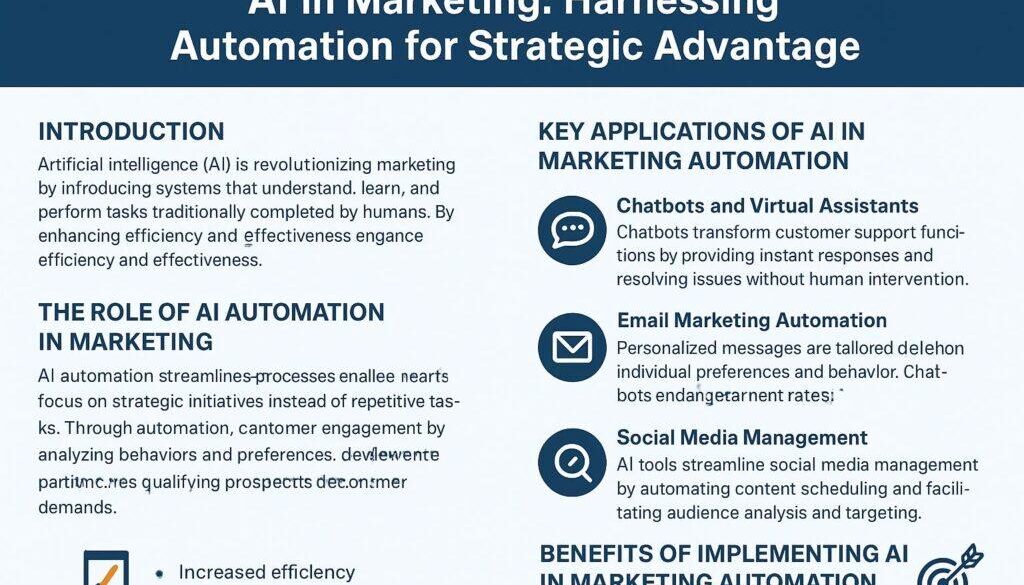
AI in Marketing: Harnessing Automation for Strategic Advantage
Introduction
Artificial Intelligence (AI) is revolutionizing marketing by introducing systems that understand, learn, and perform tasks traditionally completed by humans. As businesses increasingly adopt AI automation, it becomes paramount to leverage these technologies within marketing strategies to enhance efficiency and effectiveness. This article focuses on the role of AI automation in marketing and explores its applications, benefits, challenges, and future trends.
The Role of AI Automation in Marketing
AI automation streamlines marketing processes, enabling teams to focus on strategic initiatives instead of repetitive tasks. Through automation, marketing campaigns can be executed with precision and speed, from content creation to distribution. Furthermore, AI enhances customer engagement by analyzing behaviors and preferences, allowing marketers to deliver more personalized experiences.
Data analysis and predictive modeling powered by AI are essential for understanding market trends and consumer demands. By leveraging vast amounts of data, AI can uncover insights that inform marketing strategies and improve ROI. These capabilities make AI automation a cornerstone of successful modern marketing.
Key Applications of AI in Marketing Automation
Chatbots and Virtual Assistants
Chatbots are transforming customer support functions, providing instant responses to inquiries and resolving issues without human intervention. This not only saves time but also improves customer satisfaction by offering immediate assistance. Additionally, chatbots play a critical role in lead generation, qualifying prospects through automated conversations.
Email Marketing Automation
AI enhances email marketing through personalization, allowing brands to tailor messages based on individual preferences and behavior. This targeted approach increases engagement rates and improves customer retention. Additionally, A/B testing and optimization driven by AI help marketers analyze performance metrics and continually refine their email strategies.
Social Media Management
AI tools streamline social media management by automating content scheduling to maximize engagement at peak activity times. Moreover, AI facilitates audience analysis and targeting, helping brands understand who their customers are and what content resonates with them. This targeted approach significantly boosts the effectiveness of social media campaigns.
Benefits of Implementing AI in Marketing Automation
Integrating AI into marketing automation dramatically increases efficiency, reducing the manual labor involved in campaign management. By automating routine tasks like data entry, marketers can reallocate their time to strategic planning and creative development. This enhanced efficiency allows teams to react quickly to market changes and consumer needs.
Additionally, AI improves accuracy in targeting and segmentation by analyzing consumer data and identifying trends. Enhanced customer insights gleaned from analytics allow for better decision-making and targeted strategies, ultimately driving sales growth. These benefits position companies to outperform competitors who have not embraced AI technologies.
Challenges of AI in Marketing Automation
Despite its advantages, the integration of AI into marketing automation is not without challenges. One of the primary concerns is ensuring seamless integration with existing systems, as many companies may struggle to adapt their current infrastructure. This complexity can impede the adoption of new technologies.
Moreover, data privacy and compliance are critical considerations for businesses utilizing AI. With regulations such as GDPR, companies must be cautious about how they collect, store, and utilize customer data. A failure to adhere to these regulations can result in significant penalties and loss of consumer trust.
Dependence on quality data is another challenge, as AI systems rely on accurate and comprehensive datasets to function effectively. If the data is flawed or insufficient, it can lead to misleading insights and ineffective marketing strategies. Addressing these challenges is essential for successfully implementing AI in marketing automation.
Future Trends in AI Marketing Automation
As technology evolves, advancements in machine learning algorithms will continue to enhance AI's capabilities in marketing. These improvements will allow for even more sophisticated analysis and predictive modeling, leading to deeper insights into consumer behavior.
Greater emphasis on personalization will likely characterize the future of AI marketing automation, as consumers increasingly expect tailored experiences. Businesses that can harness AI to offer individual-centric marketing will gain a significant competitive edge.
Additionally, the expansion of AI tools and platforms presents ongoing opportunities for marketers. As more accessible and user-friendly solutions emerge, companies of all sizes will be able to implement AI-driven strategies without prohibitive costs, democratizing access to advanced marketing capabilities.
Case Studies
Numerous companies have successfully implemented AI in their marketing automation efforts. For instance, a well-known e-commerce platform utilizes AI chatbots to handle customer inquiries, significantly improving response times and increasing sales through better customer engagement. Early adopters of AI in marketing automation have learned valuable lessons, such as the importance of data quality and the need for seamless integration with existing systems.
These case studies highlight the potential of AI technologies to drive significant results when implemented thoughtfully, laying a solid foundation for future innovations in marketing automation.
Conclusion
AI's impact on marketing automation is profound, reshaping how businesses engage with customers and optimize their strategies. Embracing AI technologies not only increases efficiency and accuracy but also enhances customer insights, enabling companies to remain competitive in a rapidly evolving landscape. Marketers should actively explore the integration of AI into their strategies to harness its full potential and ensure future success.