# The Impact of AI in Marketing Through AI Automation

## Introduction

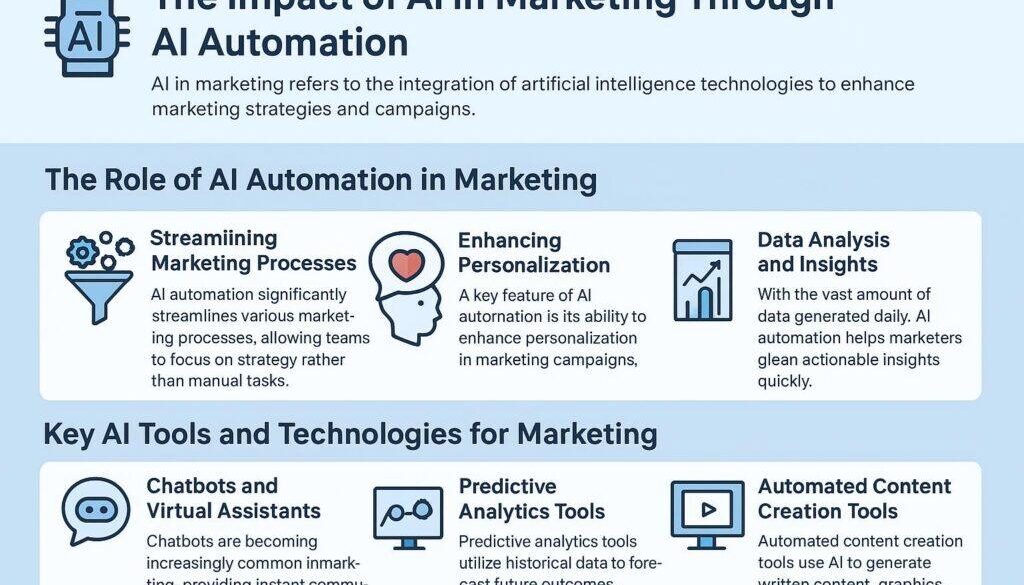
AI in marketing refers to the integration of artificial intelligence technologies to enhance marketing strategies and campaigns. This encompasses a wide range of automated processes, powered by intelligent algorithms, that make marketing efforts more efficient and effective. In today's fast-paced digital landscape, AI in marketing is essential for businesses looking to stay competitive and cater to ever-evolving customer expectations.

## The Role of AI Automation in Marketing

### Streamlining Marketing Processes

AI automation significantly streamlines various marketing processes, allowing teams to focus on strategy rather than manual tasks. By automating repetitive activities such as data entry and reporting, businesses can enhance productivity and allocate human resources more effectively. This acceleration not only improves operational efficiency but also shortens the time to market for new campaigns.

### Enhancing Personalization

A key feature of AI automation is its ability to enhance personalization in marketing campaigns. By analyzing user behavior and preferences, AI tools can tailor messages and offers to individual consumers at scale. This level of personalization leads to higher engagement rates, as customers are more likely to respond positively to content tailored specifically to their interests.

### Data Analysis and Insights

With the vast amount of data generated daily, AI automation helps marketers glean actionable insights quickly. Advanced algorithms can process and analyze data much faster than a human, identifying patterns and trends that inform better decision-making. Companies leveraging these insights can optimize their marketing strategies in real-time, leading to more effective campaigns and improved ROI.

## Key AI Tools and Technologies for Marketing

### Chatbots and Virtual Assistants

Chatbots are becoming increasingly common in marketing, providing instant communication with customers and potential leads. They can handle inquiries, provide information, and assist in the sales process 24/7. This constant availability significantly enhances customer experience and frees up human agents for more complex tasks.

### Predictive Analytics Tools

Predictive analytics tools utilize historical data to forecast future outcomes, enabling marketers to make proactive decisions. By understanding customer behavior and identifying trends, these tools help businesses tailor their marketing efforts to maximize effectiveness. This insight can lead to more targeted campaigns and better allocation of marketing resources.

### Automated Content Creation Tools

Automated content creation tools use AI to generate written content, graphics, and other media, streamlining the content production process. By automating repetitive content tasks, these tools allow marketers to focus on creativity and strategy. This innovation not only saves time but also helps maintain a consistent brand voice across various platforms.

### Email Marketing Automation

Email marketing automation is a powerful tool in AI-driven marketing strategies. These systems segment audiences, schedule campaigns, and personalize content automatically, improving both reach and engagement. The ability to analyze user interaction with emails helps refine strategies, ensuring that messages resonate with the right audience at the right time.

## Benefits of Implementing AI Automation in Marketing

### Increased Efficiency and Productivity

Implementing AI automation provides a substantial boost in both efficiency and productivity. By reducing manual tasks and optimizing workflows, teams can achieve more in less time. This increased capacity allows businesses to execute more marketing campaigns simultaneously and respond swiftly to market changes.

### Improved Customer Experience

AI-enhanced marketing strategies have a marked impact on the overall customer experience. With personalized communication, quick responses, and relevant offers, customers enjoy a more engaging and less frustrating interaction with brands. This positive experience fosters loyalty and encourages repeat business.

### Higher Conversion Rates

The precision and targeting capabilities provided by AI tools directly contribute to higher conversion rates. Marketers can present the right message to the right audience at optimal moments, significantly increasing the likelihood of conversion. Successful campaigns driven by AI result in increased sales and customer acquisition.

### Cost-Effective Marketing Strategies

AI automation can lead to significant cost savings in marketing operations. By minimizing manual labor and reducing human error, businesses can allocate resources more efficiently. Additionally, marketing campaigns powered by AI often yield a better return on investment, further enhancing cost-effectiveness.

## Challenges and Considerations

### Data Privacy and Security Issues

As businesses adopt AI automation, they must navigate concerns surrounding data privacy and security. The collection and utilization of personal data are subject to regulations such as GDPR, making compliance critical. Companies need to implement robust security measures to protect customer information from breaches.

### Integration with Existing Systems

Integrating AI automation tools with existing marketing platforms can pose challenges. Compatibility issues might arise, leading to disruptions in workflow or system inefficiencies. Businesses must ensure seamless integration, which may require additional resources and consultation.

### Maintaining Human Touch in Marketing

While AI enhances efficiency, maintaining a human touch in marketing communications is essential. Automated interactions can sometimes feel cold or impersonal, detracting from customer relationships. Striking a balance between automation and personal engagement is crucial for successful marketing strategies.

### Keeping Up with Rapid Technological Changes

The rapid pace of technological advancements in AI can be a double-edged sword for marketers. Staying abreast of new tools and trends requires continuous learning and adaptation, which can prove challenging. Companies must invest in ongoing training and development to leverage AI effectively.

## Case Studies of Successful AI Implementation in Marketing

### Example 1: Company A’s use of AI Chatbots

Company A experienced a significant increase in customer engagement after implementing AI chatbots on their website. The chatbots handled various queries and facilitated sales, resulting in improved customer satisfaction and a 35% increase in conversion rates over six months.

### Example 2: Company B’s Predictive Analytics in Campaigns

Company B utilized predictive analytics to optimize their email marketing campaigns. By analyzing past consumer behaviors, they tailored their messaging and offers, leading to a remarkable 50% reduction in unsubscribe rates and a 20% increase in email-driven sales.

### Example 3: Company C’s Automated Email Marketing Success

Company C integrated automated email marketing solutions that delivered personalized content based on user interactions. This approach increased their open rates by 40% and led to a substantial uplift in conversions while efficiently managing their email list.

## Future Trends of AI in Marketing Automation

### Advances in Machine Learning

Ongoing advancements in machine learning are set to redefine AI’s role in marketing. These technologies will enable marketers to refine their strategies further, leading to enhanced targeting and improved customer interactions. The continuous evolution of machine learning will keep pushing the boundaries of what is possible in automation.

### The Rise of Hyper-Personalization

Hyper-personalization will become increasingly vital as consumers expect tailored experiences. AI-powered algorithms will process vast amounts of data to create even more specific and relevant marketing messages. This trend will demand a shift in marketing strategies to enhance customer engagement and satisfaction.

### AI Ethics in Marketing

As AI becomes more prevalent, ethical considerations will come to the forefront of marketing practices. Issues around data biases, consent, and transparency will need addressing to build trust with consumers. Marketers must prioritize ethical AI usage to maintain their brand integrity and consumer confidence.

### Predictions for AI’s Role in Marketing Strategies

Looking ahead, AI will play a central role in shaping marketing strategies across industries. Predictions indicate that businesses that fully embrace AI technologies will outperform their competitors by establishing more efficient, personalized, and data-driven marketing efforts. The integration of AI tools is poised to redefine marketing best practices.

## Conclusion

AI automation is rapidly transforming the marketing landscape, making it more efficient, personalized, and data-driven. Businesses must adapt to these advancements to thrive in a competitive environment. By adopting AI tools and technologies, companies can enhance their marketing strategies and remain ahead of the curve, paving the way for a successful future powered by AI.