The Transformative Impact of AI Automation on Marketing Strategies
The Impact of AI Automation on Marketing: A Transformative Approach
Introduction
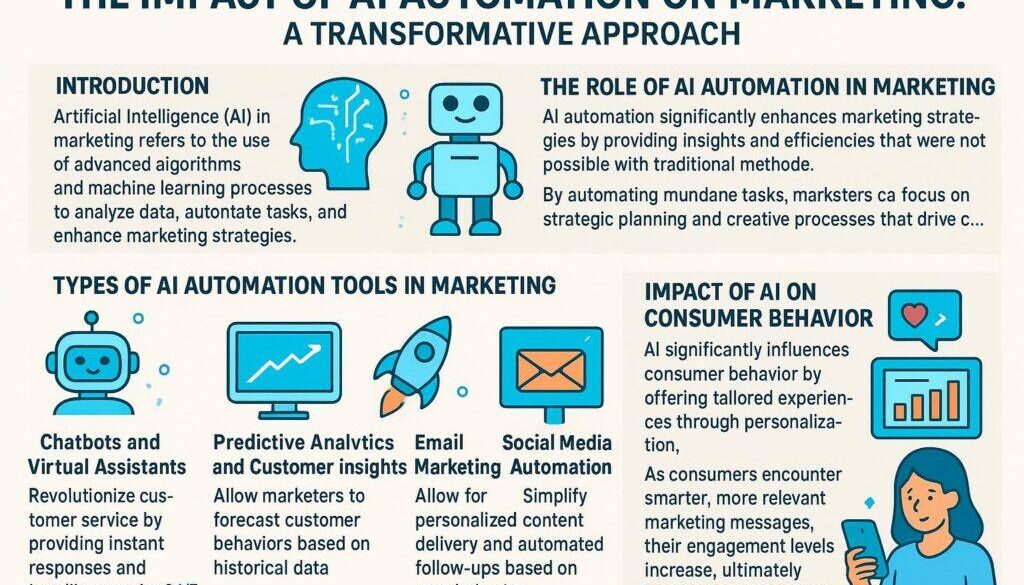
Artificial Intelligence (AI) in marketing refers to the use of advanced algorithms and machine learning processes to analyze data, automate tasks, and enhance marketing strategies. With the rise of AI automation, businesses can leverage powerful tools to streamline operations, improve customer experiences, and achieve better results. As marketing evolves, integrating AI automation becomes essential for staying competitive and meeting the demands of modern consumers.
The Role of AI Automation in Marketing
AI automation significantly enhances marketing strategies by providing insights and efficiencies that were not possible with traditional methods. By automating mundane tasks, marketers can focus on strategic planning and creative processes that drive growth. Key benefits of integrating AI automation include increased efficiency, improved accuracy in targeting, and the ability to analyze vast amounts of data quickly, which leads to more informed decision-making.
Types of AI Automation Tools in Marketing
Chatbots and Virtual Assistants
Chatbots and virtual assistants are revolutionizing customer service by providing instant responses and handling queries 24/7. These AI-driven tools enhance engagement by offering personalized experiences to users, making them essential for any marketing strategy.
Predictive Analytics and Customer Insights
Predictive analytics allows marketers to forecast customer behaviors based on historical data. This capability leads to better-targeted campaigns and improved resource allocation, as marketing efforts can be tailored to meet the specific needs and preferences of different consumer segments.
Automated Advertising Campaigns
Automation in advertising, such as programmatic advertising, enables real-time bidding and ad placements, ensuring that marketing messages reach the right audience at the right time. This not only increases the effectiveness of campaigns but also optimizes advertising spend.
Email Marketing Automation
Email marketing has evolved with AI, allowing for personalized content delivery and automated follow-ups based on user behavior. This leads to higher open and conversion rates, as messages resonate more deeply with recipients.
Social Media Automation Tools
Social media automation tools simplify content scheduling and performance tracking across various platforms. By using AI to analyze engagement metrics, marketers can refine their strategies to enhance brand visibility and customer interaction.
Impact of AI on Consumer Behavior
AI significantly influences consumer behavior by offering tailored experiences through personalization. As consumers encounter smarter, more relevant marketing messages, their engagement levels increase, ultimately leading to higher conversion rates. Furthermore, AI insights improve targeting and segmentation, enabling businesses to nurture relationships with customers in a more meaningful way.
Case Studies: Successful Implementation of AI in Marketing
Example 1: Company A
Company A implemented AI chatbots for their customer service department, allowing for a significant reduction in response times and operational costs. Customers reported higher satisfaction rates due to the efficiency and helpfulness of the chatbots, which provided instant assistance.
Example 2: Company B
Company B capitalized on AI-driven personalized marketing campaigns that leveraged customer data to tailor messages effectively. This approach not only enhanced customer engagement but also increased their return on investment significantly, demonstrating the power of AI in crafting targeted communications.
Example 3: Company C
Company C utilized automation in data analysis to drive better decision-making. By integrating AI tools into their analytics processes, they were able to uncover valuable insights, enabling swift adjustments in marketing strategies that ultimately led to improved performance metrics.
Challenges and Considerations when Implementing AI Automation
Despite its numerous advantages, implementing AI automation comes with challenges that businesses must navigate. Data privacy remains a crucial consideration, as companies must ensure compliance with regulations while handling sensitive customer data. Additionally, over-dependence on technology can lead to reduced human interaction, thus disconnecting brands from their consumers. Lastly, the skills gap presents a hurdle, highlighting the need for ongoing training to equip marketing teams with the expertise required to leverage AI tools effectively.
Future Trends of AI in Marketing
As technology continues to evolve, so will the role of AI in marketing. Emerging technologies, such as advanced machine learning and natural language processing, promise to further enhance marketing strategies by delivering even more precise insights. The future will likely see increased human-AI collaboration, where marketers work alongside AI systems to create innovative solutions that not only drive sales but also foster deeper customer relationships.
Conclusion
AI automation is transforming marketing by enhancing efficiency, personalization, and decision-making. Companies that adopt AI tools not only improve their marketing strategies but also secure a competitive edge in a rapidly changing landscape. Embracing AI automation is essential for future success, as it allows businesses to meet and exceed consumer expectations in an increasingly digital world.
Call to Action
Explore the potential impact of AI automation tools on your marketing outcomes. Consider subscribing to industry newsletters or following thought leaders in AI marketing to stay updated on the latest trends and insights. Embracing these technologies can significantly enhance your marketing strategies and drive sustainable growth.