Unlocking the Future of Marketing: The Essential Role of AI Automation in Enhancing Customer Engagement
AI in Marketing – The Role of AI Automation
I. Introduction
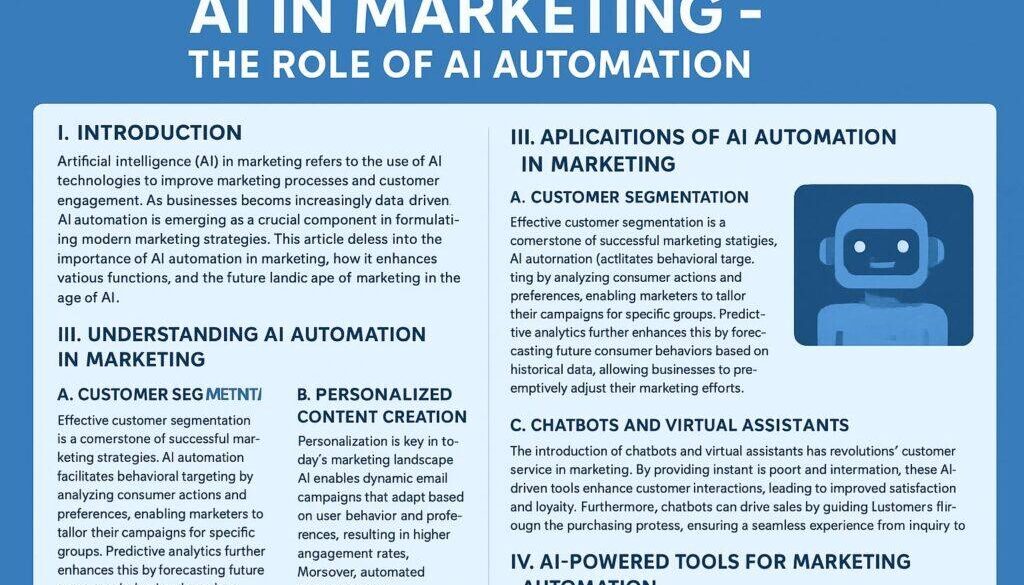
Artificial Intelligence (AI) in marketing refers to the use of AI technologies to improve marketing processes and customer engagement. As businesses become increasingly data-driven, AI automation is emerging as a crucial component in formulating modern marketing strategies. This article delves into the importance of AI automation in marketing, how it enhances various functions, and the future landscape of marketing in the age of AI.
II. Understanding AI Automation in Marketing
AI automation enables marketers to streamline and optimize their processes by leveraging advanced technologies to analyze large datasets and interpret consumer behavior. This includes techniques such as Machine Learning, which allows systems to learn from data and improve over time, and Natural Language Processing (NLP), which enhances customer interactions through better communication. The integration of AI automation in marketing leads to increased efficiency, improved targeting, and enhanced customer experiences.
III. Applications of AI Automation in Marketing
A. Customer Segmentation
Effective customer segmentation is a cornerstone of successful marketing strategies. AI automation facilitates behavioral targeting by analyzing consumer actions and preferences, enabling marketers to tailor their campaigns for specific groups. Predictive analytics further enhances this by forecasting future consumer behaviors based on historical data, allowing businesses to preemptively adjust their marketing efforts.
B. Personalized Content Creation
Personalization is key in today’s marketing landscape. AI enables dynamic email campaigns that adapt based on user behavior and preferences, resulting in higher engagement rates. Moreover, automated tools can create customized landing pages that resonate with different customer segments, ensuring that each visitor encounters relevant content tailored to their interests.
C. Chatbots and Virtual Assistants
The introduction of chatbots and virtual assistants has revolutionized customer service in marketing. By providing instant support and information, these AI-driven tools enhance customer interactions, leading to improved satisfaction and loyalty. Furthermore, chatbots can drive sales by guiding customers through the purchasing process, ensuring a seamless experience from inquiry to checkout.
D. Marketing Analytics and Reporting
AI automation has transformed the way marketers analyze their campaigns. With real-time data interpretation capabilities, businesses can swiftly assess campaign performance to make informed decisions. This not only aids in optimizing ongoing campaigns but also helps in strategizing future marketing efforts based on data-driven insights.
IV. AI-Powered Tools for Marketing Automation
A. Overview of Popular AI Tools
Several AI-powered tools are revolutionizing the marketing landscape. HubSpot, for instance, integrates a variety of marketing tasks into one platform, while Marketo focuses on streamlined automation for lead generation. Salesforce Einstein utilizes AI to enhance customer relationship management, offering insights that drive marketing initiatives.
B. Comparisons and Key Features
When comparing these platforms, it is clear that each has unique features catering to specific marketing needs. HubSpot is user-friendly for smaller businesses, while Marketo offers advanced analytical capabilities for larger enterprises. Salesforce Einstein is noted for its intelligence in managing customer data, making it ideal for companies seeking refined insights into customer interactions.
C. Case Studies of Successful Implementation
Numerous businesses have successfully implemented AI-powered tools to boost their marketing strategies. For example, a leading e-commerce company utilized chatbots to enhance customer service, resulting in a 25% increase in customer satisfaction. Another brand harnessed predictive analytics to personalize promotions, ultimately leading to a 15% rise in conversion rates. These case studies illustrate the tangible benefits that AI automation can bring to marketing efforts.
V. Challenges and Considerations
A. Data Privacy and Ethics
While AI automation offers numerous advantages, it also raises concerns about data privacy and ethics. Businesses must navigate the complexities of consumer data usage laws while ensuring transparency in their marketing practices. Maintaining consumer trust is paramount, and companies should prioritize ethical guidelines in their AI strategies.
B. Dependence on Technology
Relying heavily on AI can lead to challenges when technology fails or provides incorrect insights. Marketers must balance technology use with human intuition and creativity to ensure that campaigns resonate on a personal level. Overdependence can also lead to a disconnect with customers if their needs are not fully understood beyond algorithmic predictions.
C. Ensuring Human Touch in Automated Communications
Automation can sometimes result in a loss of personal touch in customer communications. It’s vital for businesses to ensure that automated interactions still carry warmth and empathy. Integrating human oversight in automated communications can help maintain a personal connection, enhancing customer relationships.
VI. Future Trends in AI and Marketing Automation
A. Growth of AI Technology in Marketing
The growth of AI technology in marketing shows no signs of slowing down. As AI continues to evolve, businesses have the opportunity to harness more sophisticated tools that enhance user experiences and marketing effectiveness. The ability of AI to provide real-time insights and automated solutions will shape the future of marketing strategies.
B. New Innovations on the Horizon
Emerging innovations, such as advanced predictive analytics and AI-driven content generation, are set to further transform marketing practices. These advancements will allow marketers to engage audiences in unprecedented ways, making campaigns more targeted and effective. Staying ahead of these developments will be crucial for businesses aiming to remain competitive.
C. The Evolving Role of Marketers in an AI-Driven Landscape
As AI takes on more responsibilities, the role of marketers will shift dramatically. Marketers will need to become adept at interpreting data and leveraging AI tools while retaining their strategic and creative instincts. Embracing this change will be essential for marketers as they navigate the complexities of an AI-driven landscape.
VII. Conclusion
In summary, AI automation is a game-changer in the marketing industry, driving efficiency and personalizing customer interactions. As businesses prepare for an AI-integrated future, adopting these technologies will be vital to staying relevant and competitive. Companies are encouraged to explore AI strategies that align with their marketing goals to harness the full potential of automation in their campaigns.