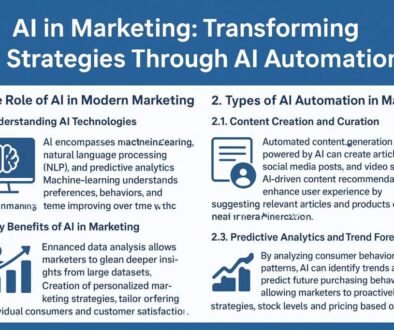

Harnessing AI Automation in Marketing: Strategies for Enhanced Consumer Engagement and Efficiency
AI in Marketing: Enhancing AI Automation
Introduction
Artificial Intelligence (AI) in marketing refers to the use of machine learning algorithms and data analysis to enhance marketing strategies and improve customer interactions. The integration of AI automates processes, enabling marketers to work more efficiently and effectively. This article explores the vital role of AI in marketing, the tools available, real-world applications, and future trends that businesses must consider.
The Role of AI in Marketing
Understanding Consumer Behavior
AI significantly aids in understanding consumer behavior by leveraging predictive analytics and customer segmentation. Predictive analytics uses historical data to forecast future customer actions, allowing marketers to tailor their strategies effectively. Customer segmentation, on the other hand, categorizes consumers into groups based on behavior and preferences, making it easier to create targeted campaigns.
Personalized Marketing
Personalized marketing has become a cornerstone of modern strategies, and AI plays a critical role in this area. With AI-driven dynamic content recommendations, brands can deliver tailored messages based on individual user data and behavior. Additionally, personalized email campaigns powered by AI algorithms ensure that customers receive relevant content, boosting engagement and conversion rates.
Content Generation
Content generation has also evolved with the advent of AI tools that assist in copywriting and automated content curation. AI copywriting tools can produce engaging articles, social media posts, and ad copies, significantly saving time for marketers. Automated content curation helps in sourcing and sharing relevant articles, ensuring that brands remain active and informative in their niche.
AI Automation Tools in Marketing
Overview of Popular AI Marketing Tools
Many AI-driven marketing tools have emerged, transforming how businesses engage with customers. Chatbots are one of the most recognizable, providing customer service automation by answering inquiries in real-time, improving customer satisfaction. AI-driven social media management tools analyze engagement data to optimize posting schedules and content types, enhancing overall reach.
Integrating AI Automation into Marketing Workflows
Integrating AI automation into marketing workflows can streamline processes and improve efficiency. By incorporating AI into Customer Relationship Management (CRM) systems, businesses can better analyze customer interactions and history to enhance service. Additionally, AI improves lead scoring systems by analyzing data to identify the most promising leads, allowing for more focused efforts.
Case Studies of Successful AI Automation in Marketing
Company A: Transforming Customer Engagement with AI Chatbots
Company A implemented AI chatbots on their website, resulting in a remarkable increase in customer engagement. These chatbots responded to common inquiries, freeing up human agents to handle more complex issues. The reduction in response time led to higher customer satisfaction scores and enhanced loyalty.
Company B: Using Predictive Analytics for Targeted Advertising
Company B adopted predictive analytics to refine its advertising strategies. By analyzing historical data, they could target ads more effectively, increasing the return on advertising spend (ROAS). Their targeted campaigns led to a significant uptick in conversions as they reached the right audience at the right time.
Company C: Automating Content Creation for Improved ROI
Company C utilized AI for content creation, automating blog posts and social media updates. This strategy allowed them to increase their output without sacrificing quality. As a result, they observed an improved ROI, as their audience became more engaged with consistent, high-quality content that met their interests.
Challenges and Considerations
Potential Pitfalls of AI in Marketing
Despite the advantages, there are potential pitfalls of integrating AI in marketing. Data privacy concerns are at the forefront, as consumers become increasingly wary of how their data is used. Additionally, an overreliance on automation can diminish the human aspect of marketing, potentially alienating customers who seek genuine connections.
Best Practices for Implementing AI Automation
To mitigate these risks, businesses should adopt best practices for implementing AI automation in their marketing strategies. Striking a balance between human touch and automation ensures that customers feel valued and understood. Moreover, continuous monitoring and optimization of AI systems are essential to adapt to changing consumer expectations and improve performance.
Future Trends in AI and Marketing Automation
Advances in Machine Learning and Its Impact on Marketing
As machine learning technology advances, its impact on marketing strategies will continue to grow. Enhanced algorithms will allow for even more precise targeting and deeper insights into consumer behavior. Businesses that leverage these advancements will likely see improved customer engagement and loyalty.
The Role of AI in Evolving Customer Expectations
AI is set to further evolve customer expectations as consumers increasingly demand personalized experiences. Brands leveraging AI to fine-tune their marketing efforts will be at a significant advantage, meeting and exceeding these expectations. This shift emphasizes the need for marketers to stay ahead of the curve in adopting AI technologies.
Emerging Technologies to Watch
Emerging technologies such as voice recognition and augmented/virtual reality (AR/VR) are poised to revolutionize marketing automation. These innovations offer new channels for engagement and interaction, enabling brands to connect with consumers in unprecedented ways. Embracing these technologies will be crucial for companies looking to maintain a competitive edge.
Conclusion
AI automation in marketing offers numerous benefits, including enhanced efficiency, improved customer understanding, and personalized experiences. As the landscape continues to evolve, adapting to advancements in AI technologies will provide a significant competitive advantage. Businesses must embrace these changes and integrate AI into their marketing strategies to thrive in the future.